True to the Flavor
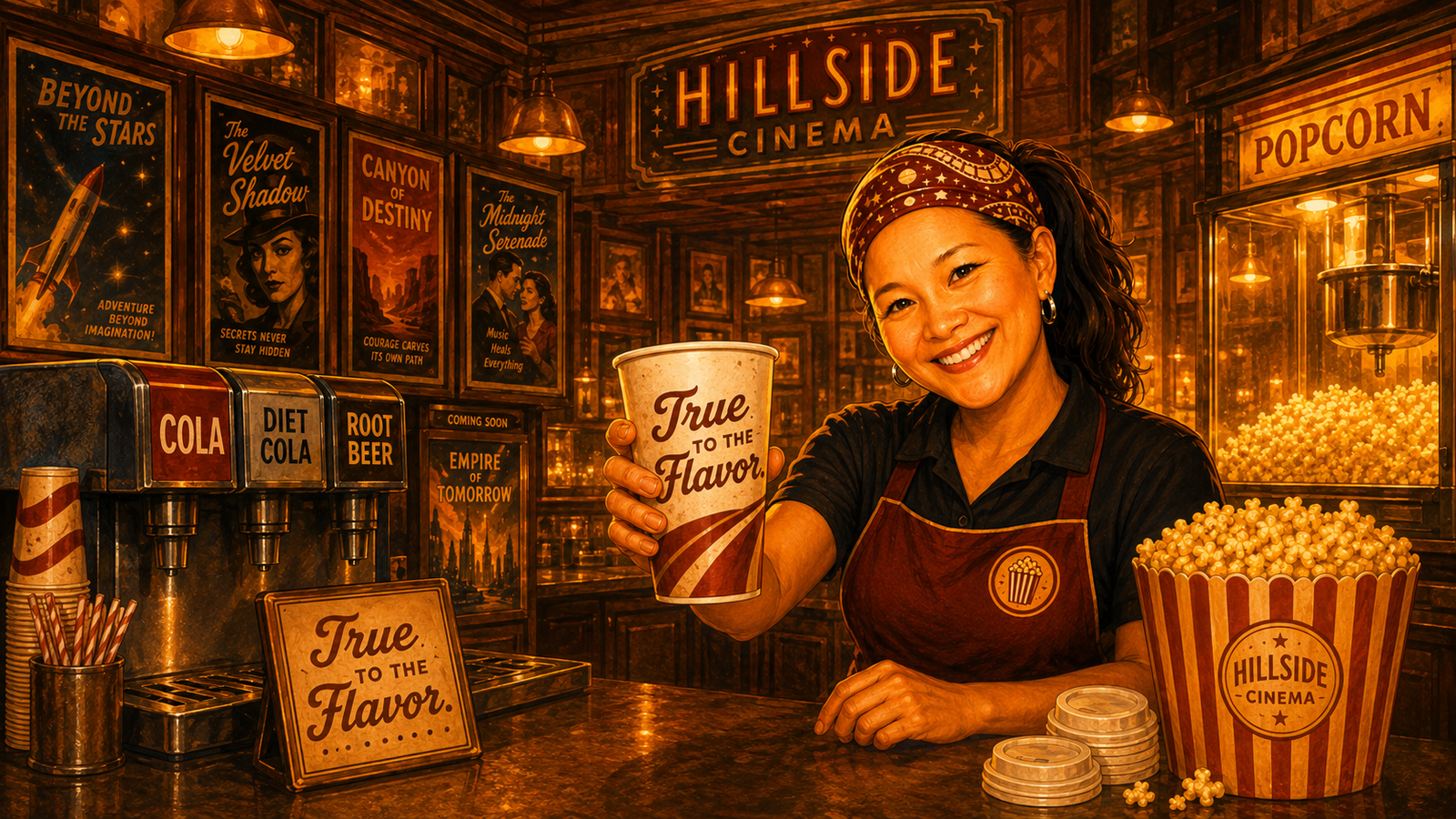
All through high school, I worked behind the concession counter at Hillside Cinema. It was a pretty good job for a teenager. I could watch movies for free, and those happened to be the years of The Empire Strikes Back, Raiders of the Lost Ark, E.T., and Return of the Jedi. We could also have all the popcorn and soda we wanted, which may have been the closest thing to an employee retirement plan available to us at the time.
Of course, free movies did not always mean good movies. I remember walking out of Losin’ It and telling my friends behind the concession counter, “Hideous movie. But that kid with the kinda big nose—there’s something magnetic about him. He’s gonna be a star.”
That kid was Tom Cruise.
So, apparently, my ability to recognize a future movie star was already better developed than my ability to choose a movie.
Each of us brought a cup from home so we would not throw off the theater’s inventory count. I had a couple of my own that made regular trips behind the counter.
The soda did not arrive at the machine already mixed. A box held the syrup. Water came through a separate line and was carbonated by a CO2 tank. The dispenser brought them together. At least, that was the idea.
Each flavor had to be calibrated separately. When the balance was right, the soda tasted the way it was supposed to taste. When it was not, you knew. Too much syrup, and it was thick and overly sweet. Too little, and it tasted like someone had waved a bottle of cola over a glass of soda water and hoped for the best.
Often, the first sign that a machine needed attention was a guest returning to the concession stand. They had already found their seat, settled into the movie, taken a drink—and discovered that what was in the cup was not what they had expected. They were rarely delighted to leave the movie and come tell us about it.
We asked which concession line they had used so we could identify the machine. Then we took care of the guest first, replacing the drink from another dispenser so they could get back to the theater. After that, we checked the machine.
We did not assume it was wrong simply because someone complained. Because, honestly, some people have taste buds that are not exactly the industry standard. We poured a little soda into one of our own cups and tasted it ourselves.
If it was off, I used a screwdriver to turn one adjustment screw a little. Back then, I knew which direction. I do not remember now, and I refuse to invent left or right for the sake of spiritual enlightenment.
I poured another sample. Tasted again. Adjusted a little more if necessary. Tasted again. The process continued until the soda was true to its flavor.
Most problems could be handled that way. But if what came out was flat, syrupy water, the CO2 tank needed attention. Turning the little screw was not going to restore what was missing. That was a job for the manager.
Years later, I realized those machines had been teaching me something about calibration in my own life.
Sometimes another person notices first. They hear the impatience in my voice or feel the distance in my response. I may not agree with everything they say—remember the taste buds—but I can pay attention.
First, find the line. What was happening? What came through me? Then taste it for myself.
What is coming through me right now? Does it taste like me, or have I drifted a little out of balance?
The machine had started out good to go—perfectly calibrated. It did not need a new identity or a complete overhaul. The proportions had simply drifted.
I think of the True Self as our factory setting: already whole, already balanced. Divine Love is not an upgrade we have to purchase or install. It came standard.
Life, however, has a way of jostling the settings. I get tired, hurried, or distracted. Irritation comes through stronger than patience. Being right starts to matter more than listening.
None of that changes who I am. It may only mean that what is coming through me does not taste much like me at the moment.
So I calibrate. I pause before speaking. I soften my tone or listen a little longer. I am still, I go within. I remember and return to what is True.
At Hillside, every flavor had to be calibrated separately. There was no one setting that made every soda taste right. Each had its own balance.
The same is true of us. I do not need to taste like anyone else, and neither do you. Calibration is not about sameness. It lets our own flavor come through clearly.
Most of the time, a little tweak may be enough. But flat, syrupy water meant something else was wrong. The carbonation was not flowing, and that was when I went to the manager.
Some days I can pause, listen, and make the adjustment myself. Other days, I need the Manager—Divine Presence. I get still, ask for guidance, and let myself be restored to balance.
RC Cola had its own flavor. I suppose I have mine, too—KC Cola!
So do you.
That, to me, is the spiritual practice of calibration: noticing when we have drifted, making the adjustment that is ours to make, and returning to our original setting. We are not becoming someone else. We are letting the unique expression of Divine Love that we are to come through again.
And the taste is simply divine.