waka waka waka
Waka Waka Waka
In my early twenties, I was obsessed with Ms. Pac-Man.
Waka waka waka, baby.
I became pretty adept at clearing those narrow corridors, saving the power pellets for crucial moments and gathering the ghosts so I could get them all in one glorious swoop. Actually, I suppose I was only a fair-to-middlin’ player. If I had been better, I would have saved countless rolls of quarters.
I was not one for standing around in an arcade. I preferred the tabletop machines, where I could sit with a glass of soda within easy reach. One hand worked the controls. The other reached for my drink.
Hunting lil’ ghosts works up a thirst.
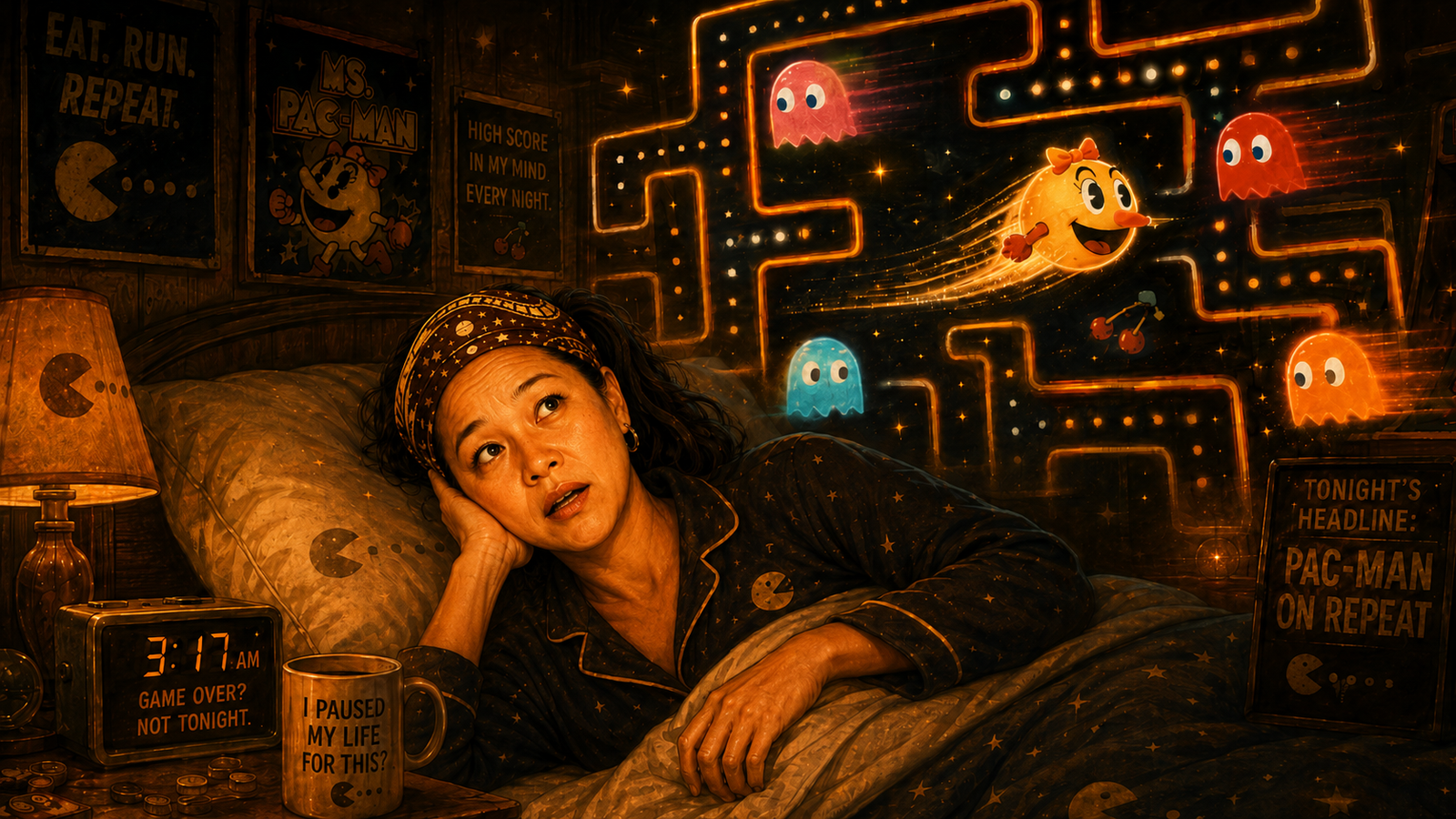
After hours of play, I would finally go home. Later that evening, all set for sleep, I would close my eyes and—
Waka waka waka.
There she was. Ms. Pac-Man darted through the maze while the red, pink, blue and orange ghosts crowded the corridors behind her.
Left. Right. Up. Down. Turn. Run. Double back.
Wait for the power pellet.
Now chase.
I was nowhere near the arcade, but the game kept playing behind my eyelids. I was still gathering ghosts, still waiting for the right moment, still trying not to get caught.
Interesting, to say the least.
And annoying.
Once my obsession died down and I was no longer feeding quarters into the machine for hours, day after day, the little bedtime late show finally went off the air.
I have since learned that this experience is sometimes called the Tetris Effect. When we give substantial time and attention to a repetitive activity, its patterns may continue replaying in our thoughts, perceptions and dreams.
My body had left the arcade. My attention was still running the corridors.
Which makes me wonder what else keeps playing after the machine is turned off. What have we watched, rehearsed or worried over so often that it follows us into the quiet?
There is an old teaching: What we focus on expands. Energy flows where attention goes. Thoughts held in mind tend to produce after their kind.
What we repeatedly look for, we become more practiced at seeing.
I learned this in a much less dramatic place than an arcade: the grocery store checkout line.
For a while, it seemed that every cashier I encountered was rude, bored or wishing to be anywhere else. Their eyes stayed on the register while my groceries moved across the scanner. If I took too long entering my phone number for the store discounts, I could feel the impatience waiting on the other side of the keypad.
I would stiffen. They would say little. I would say less.
Cold met cold. Dismissive met dismissive.
Then I began thinking about it differently. I did not know what had happened before I rolled my cart into that line. I did not know how many hours the cashier had been standing there or what might be waiting when the shift ended.
So I gave myself a small assignment: look for something good.
At first, it felt forced. I might notice someone’s bright purple hair.
“You look amazing! How long does the dye stay in?”
I might ask about an interesting pair of tennis shoes or say that I appreciated the care someone took doing the job. I looked for something I could honestly notice, then opened my mouth and said it.
There was one woman I regularly encountered at Jewel-Osco. At first, I thought she scowled all the time. She was quiet, not especially talkative, and I had already formed an opinion about her.
Then I became curious. I began asking about her day and learning a little about her interests. She opened right up.
These days, we see each other and smile. We chat while she rings up my groceries.
It is all quite lovely.
Then there is David at Casey’s. I have a thing for slushies.
David was never rude. He was simply quiet, doing his job. I could have filled my cup, placed my icy treat on the counter, paid and left without knowing anything about the man standing there.
Instead, I began asking questions. Now when I walk into Casey’s, I am not only thinking about the slushie machine. I am glad to see David.
And it’s not just about my icy treat.
I had looked at the woman at Jewel-Osco and seen a scowl. I had looked at David and seen someone quietly doing his job. When I stayed a little longer, asked another question and allowed myself to become curious, more of each person came into view.
They had been there all along.
Perhaps I found the good in them. Perhaps my attention helped create the conditions in which the good between us could emerge.
I think it was both.
Looking for the good has also changed what happens inside me when I do not yet know what something means.
There was a time when someone could say, “I want to talk with you later, but I can’t right now,” and my mind would immediately send four ghosts racing after me.
Did I offend them? Did I forget to do something? Did I let them down? What did I do?
No additional information was required. My mind could build the whole maze by itself.
I would turn the unfinished sentence over and over, searching for the corner where trouble must be waiting. I was not waiting to learn why they wanted to talk. I was waiting for the other shoe to drop.
These days, I practice letting the sentence remain unfinished. Perhaps they want to spend time together. Perhaps they have something meaningful to share.
Perhaps there is no ghost chasing me through the corridor at all.
I do not have to fill every blank space with fear. I can leave room for good.
Looking for the good does not mean covering something painful with a cheerful sticker or ignoring what needs our care. It means fear, lack and annoyance no longer get every quarter I have.
Years ago, Unity Worldwide offered a campaign called Look for the Good.
Sounds like something worth devoting my attention to.
A gratitude journal is one simple way to practice. At the end of the day, we can open a notebook and call back the moments we might otherwise lose: something kind, something beautiful, something funny, something unexpectedly lovely.
Purple hair beneath grocery-store lights. A shared smile across a register. The cold cup in my hand and David behind the counter. A patch of beauty in the backyard. A kindness offered at home. One more question asked instead of walking away.
The more often we turn our attention toward such moments, the easier they become to recognize. The corridors do not disappear. We simply become less willing to spend all day chasing ghosts through them.
Perhaps this is what we want moving through us when the day is over—not old fears racing left, right, up and down, but the faces we paused long enough to see and the moments of connection we might once have missed.
Then we can lay our heads on the pillow, close our eyes and feel the corners of our mouths begin to rise, with all that good still moving through us.
And not—
Waka waka waka.